
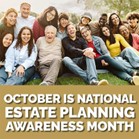
 Just a few months ago I was surprised to learn about “National Make-a-Will Month” for the first time. Now, I’ve learned about another celebration called “Estate Planning Awareness Month.” Apparently, that happens in the month of October. While I should be shocked that I failed to learn about this celebration until I left private practice, I’m not that shocked, because many attorneys, me included, spend much of their time devoted to solving client issues and miss holidays and celebrations both big and small. As a Trusts and Estates professional, I think having a month dedicated to Estate Planning awareness is spectacular!
Simply put, an Estate Plan serves as a set of instructions regarding how you want your affairs handled if something happens to you. A basic Estate Plan contains documents instructing your family and loved ones what you want to happen both during your life and at death. Those documents consist of a Living Trust, also known as a Revocable Trust (a “Trust”), a Will, a Property Power of Attorney, a Healthcare Power of Attorney, a Living Will, and a Health Insurance Portability and Accountability (“HIPAA”) Authorization. In keeping with the theme of Estate Planning awareness, let’s review the role that each document plays.
While the Trust often comes first in the list of documents necessary for a complete Estate Plan, starting with the Will makes more sense. A Will determines distribution of your assets upon your death and allows you to select an individual or company to make those disbursements. In addition, the Will allows you to nominate guardians to care for any minor children whom you leave behind at your death. Finally, most states allow their residents to pass tangible personal property through a separate writing without the formalities required of a Will but require the Will to mention this separate writing.
If you do not have a Will, then your state’s intestacy laws will govern the distribution of your assets at your death. Many states’ intestacy laws give only a portion of assets to the surviving spouse and give the remainder to descendants, without regard for the specific needs of the individual recipients. This includes those who may have special circumstances, such as receiving needs-based governmental benefits. If you die intestate, or with just a Will and not a Trust, then your estate will likely need to go through probate which is a public process. This means that otherwise private information about the nature and extent of your assets and the beneficiaries of those assets would be divulged. This could allow nosy neighbors, predators, and others to pry into your life and the lives of your loved ones.
Trusts provide the solution to the probate issue. They allow the beneficiaries to forego the probate process altogether. The Trustor creates a Trust and appoints a Trustee to administer the Trust without court intervention. In this way, properly funded Trusts avoid probate because the Trust that holds the assets doesn’t die or become incapacitated. If, however, the decedent died with just one asset titled in his or her name then that asset would need to pass through probate. Thus, even if you have a Trust, you still need a Will. Assets sometimes remain titled in the name of the Trustor at death and in most states, the only way to ensure that these assets end up in the Revocable Trust is through the “Pour-over Will” that “pours” any assets passing through probate “over” to the Trust. The Will serves as a companion document and acts as a backstop to the Trust. Further, a well-drafted Will includes provisions that direct passage of the assets in accordance with the terms of the Trust which protects the distribution plan if a court declares the Trust invalid for any reason.
The Trust also protects against incapacity by giving a successor Trustee the power to make distributions from the Trust for your benefit should you become incapacitated. Due to cases of fraud, institutions more readily recognize a successor Trustee acting on your behalf than an agent under your Property Power of Attorney, but the Property Power of Attorney plays a vital role in your Estate Plan as well. Property Power of Attorney allows you to appoint someone as your “Agent” to act on your behalf concerning your financial affairs during your life. The Agent receives powers inherent to you which give them the right to make decisions about your finances immediately upon signing. In most states, you also have the option to make the Property Power of Attorney “springing,” meaning that the Agent’s powers “spring” into action only upon your incapacity. A “durable” Property Power of Attorney continues to be effective during your incapacity. A Property Power of Attorney that is not durable does not allow your Agent to act during your incapacity.
A Healthcare Power of Attorney allows you to appoint an agent to make medical decisions for you if you are unable to do so. If you can make these decisions, then your agent cannot veto any medical decision you make. A Living Will, sometimes called an “Advance Directive,” expresses your wishes regarding end-of-life decisions. Without this document memorializing your wishes, doctors and medical professionals must keep you alive even if you have no reasonable chance of recovery notwithstanding that doing so only prolongs your suffering. Attorneys and Estate Planning professionals often combine the Living Will and Healthcare Power of Attorney into one document. The Health Insurance Portability and Accountability Act mandates that healthcare providers keep your protected healthcare information confidential. While that generally makes sense, sometimes others need access to that information, especially the fiduciaries nominated to act upon incapacity. A HIPAA Authorization allows you to appoint one or more individuals to access or receive protected health information.
The Trust represents the gold standard in Estate Planning. Trusts contain flexibility, provide for continuity, avoid probate, and allow the Trustor to include protections and/or restrictions for their beneficiaries. It’s rarely wrong to create a Trust, but the Trust cannot complete the job alone. The Trust needs the Will to accomplish certain tasks, such as getting control of all the decedent’s assets if any were not titled in the Trust at the decedent’s death. The Will is essential for other reasons, such as nominating who should serve as guardian for your minor children. In addition to the Trust and Will, the Property Power of Attorney, Healthcare Power of Attorney, Living Will, and HIPAA Authorization round out the comprehensive Estate Plan. If you have questions about your Estate Plan, how it works, or whether it’s appropriately structured, let “Estate Planning Awareness Month” remind you of the continuing need for Estate Planning and reach out to a qualified Trusts and Estates practitioner to review and update your plan.
Tereina Stidd, J.D., LL.M.
Associate Director of Education
American Academy of Estate Planning Attorneys, Inc.
9444 Balboa Avenue, Suite 300
San Diego, California 92123
Phone: (858) 453-2128
www.aaepa.com

- Declare Your Independence From Intestacy - June 25, 2026
- Still Fighting: The Estate Planning Legacy of Shannen Doherty - June 9, 2026
- When Estate Planning Documents Say One Thing—and Mean Another - May 21, 2026

