
 How the Dunning-Kruger Effect Can Lead to Mindset Challenges in Estate Planning Law Firms
 How the Dunning-Kruger Effect Can Lead to Mindset Challenges in Estate Planning Law Firms
You’ve just wrapped up a challenging estate planning case. It required a detailed understanding of trust law, nuanced tax considerations, and careful drafting to ensure your client’s legacy is protected. You should feel confident. But instead, there’s a nagging doubt in your mind: Did I miss something? Could I have done more?
Many estate planning attorneys experience this kind of doubt as they advance in their careers. Oddly enough, it’s not because you lack expertise—it’s because you’ve gained so much. This phenomenon is known as the Dunning-Kruger effect, and it plays a significant role in shaping how you view your abilities and position yourself in the marketplace.
The Dunning-Kruger Effect: A Story of Overconfidence
In 1999, psychologists David Dunning and Justin Kruger of Cornell University wanted to test a question they had. They wanted to know if people could be aware of their own incompetence in a specific topic. To test this, they gave undergraduate students a 20-question logic test and then asked the students to rate their own performance in two ways. First, they were asked to estimate how many questions they thought they had answered correctly. Second, the students were asked to estimate how well they thought they did compared to their peers. The questions challenged students to judge not just their own abilities, but also how they compared to those of others.
What Dunning and Kruger discovered was surprising. Students who performed poorly on the test often overestimated their abilities. In fact, the least competent participants thought they were among the top performers. Dunning and Kruger also found that the more competent a student was on the topic, the more they underestimated their abilities. It took very high levels of competence for people to start equaling the confidence of the incompetent, resulting in a curve similar to the one below:
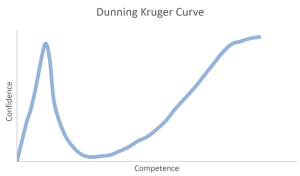
Simply put, people with limited knowledge in a subject overestimate their competence, while those with deep expertise doubt themselves. For competent estate planning attorneys, this cognitive bias often manifests as second-guessing yourself. As you gain more knowledge and begin to understand the complexities of your field, you start to doubt your abilities just like Dunning and Kruger’s high-performing students underestimated their own performance. Meanwhile, less knowledgeable professionals, like non-estate planning attorneys or financial planners, may confidently offer estate planning services without fully grasping the nuances involved.
The Mindset Shift: Doubts that Impact Key Decisions
As your understanding of estate planning deepens, you become more aware of the complexities and risks involved in even the simplest cases. What seemed straightforward when you were just starting out now appears full of potential pitfalls. I have seen this happen time and again as a Practice Building Coach. What’s worse is what comes next.
The real tragedy of your lack of confidence is that it shapes how you compete in a market filled with non-experts. Financial planners and non-estate planning attorneys overestimate their abilities and flood the market with cheap and deeply flawed estate plans. They confidently yet incorrectly brag about their estate plans, while you as an estate planning attorney quietly sit with your doubt.
The Dunning-Kruger effect creates big mindset challenges which interfere with every key decision you make in your estate planning practice. You might find yourself:
- Undervaluing your services: You may set your fees too low, feeling your knowledge isn’t “complete” enough to charge what you’re worth—despite being more qualified than non-specialists who confidently set higher fees.
- Hesitating to market yourself: You might hold back from marketing, hesitant to present yourself as an expert, while others, less knowledgeable, promote themselves aggressively.
- Showing reluctance to network: You may shy away from networking, fearing you’ll appear overconfident. This hesitation can cost you opportunities to build valuable relationships.
- Creating workflow inefficiencies: Second-guessing yourself can lead to over-researching or reworking tasks, wasting time and preventing you from taking on more cases.
This mindset shift can make you feel like you’re not doing enough, or worse, that you need to commpromise your standards just to compete with less specialized professionals. The truth is, your knowledge is your strength, and it’s exactly what sets you apart.
Breaking Free: Strategies to Overcome the Mindset of Doubt
So how do you overcome the mindset challenges caused by the Dunning-Kruger effect and fully leverage your expertise? Here are some strategies to help you shift your mindset and confidently position yourself as a trusted advisor to your clients:
- Embrace your role as a problem solver: Your clients aren’t coming to you because they need someone who knows everything—they’re coming to you because they need someone who they trust to find solutions to their problems. Reframe your mindset to focus on your ability to problem solve, to research, to compassionately listen and understand your clients.
- Recognize the value of your experience: Acknowledge that your experience in handling complex estate planning cases is a rare asset. You’ve successfully navigated issues that many non-estate planning professionals wouldn’t even recognize. Remind yourself that the ability to identify and address nuances is what makes you an effective attorney, even if it feels like there’s always more to learn.
- Reframe your mindset about pricing: Your pricing should reflect your level of service, your skill, your depth of understanding, and the value of the solutions you provide. Just because you see the potential complexities doesn’t mean your work is worth less—it means you’re better equipped to protect your clients from costly mistakes.
- Combat hesitation with targeted marketing: While the Dunning-Kruger effect may make you hesitant to market yourself, remember that your clients need to know what you offer. Use client testimonials, case studies, and real-world examples to demonstrate your ability to handle complex situations. This can help shift your mindset from self-doubt to one of showcasing the real value you provide.
- Leverage your professional relationships: Engaging with others—whether they’re estate planning professionals or from adjacent fields—can help reinforce your own confidence. Surround yourself with peers in organizations like the American Academy of Estate Planning Attorneys, where you can exchange knowledge and continue growing. Remember, you do not need to know everything, and having access to experts is a great way to learn.
Embracing a Confident Mindset: Why Your Expertise Matters
It’s time to shift your mindset. The Dunning-Kruger effect may create doubts about your abilities, but your growing awareness of complexity is your strength, not your weakness. While others confidently market estate planning services without fully understanding the risks and nuances involved, you know what to watch out for. That knowledge is invaluable to your clients, and it’s why you can—and should—set your fees appropriately, market yourself effectively, and build strong professional networks.
As you continue to grow, embrace the mindset of a problem-solver, a protector of legacies, and a trusted guide for clients navigating the complexities of estate planning. The depth of your expertise is your competitive advantage. It’s time to leverage that knowledge, with confidence, and stand out in a crowded field. Contact us to gain further help in fixing your mindset – https://www.aaepa.com/contact/
Timour Mobarak
Practice Building Coach
American Academy of Estate Planning Attorneys, Inc.
9444 Balboa Avenue, Suite 300
San Diego, California 92123
Phone: (858) 453-2128
www.aaepa.com

- Why Discipline Matters More Than Motivation in a Growing Estate Planning Firm - September 17, 2026
- Common Operational Mistakes That Lead to Client Complaints - August 6, 2026
- Leading a Team vs Managing Tasks: What Changes for Estate Planning Firm Owners - June 18, 2026

